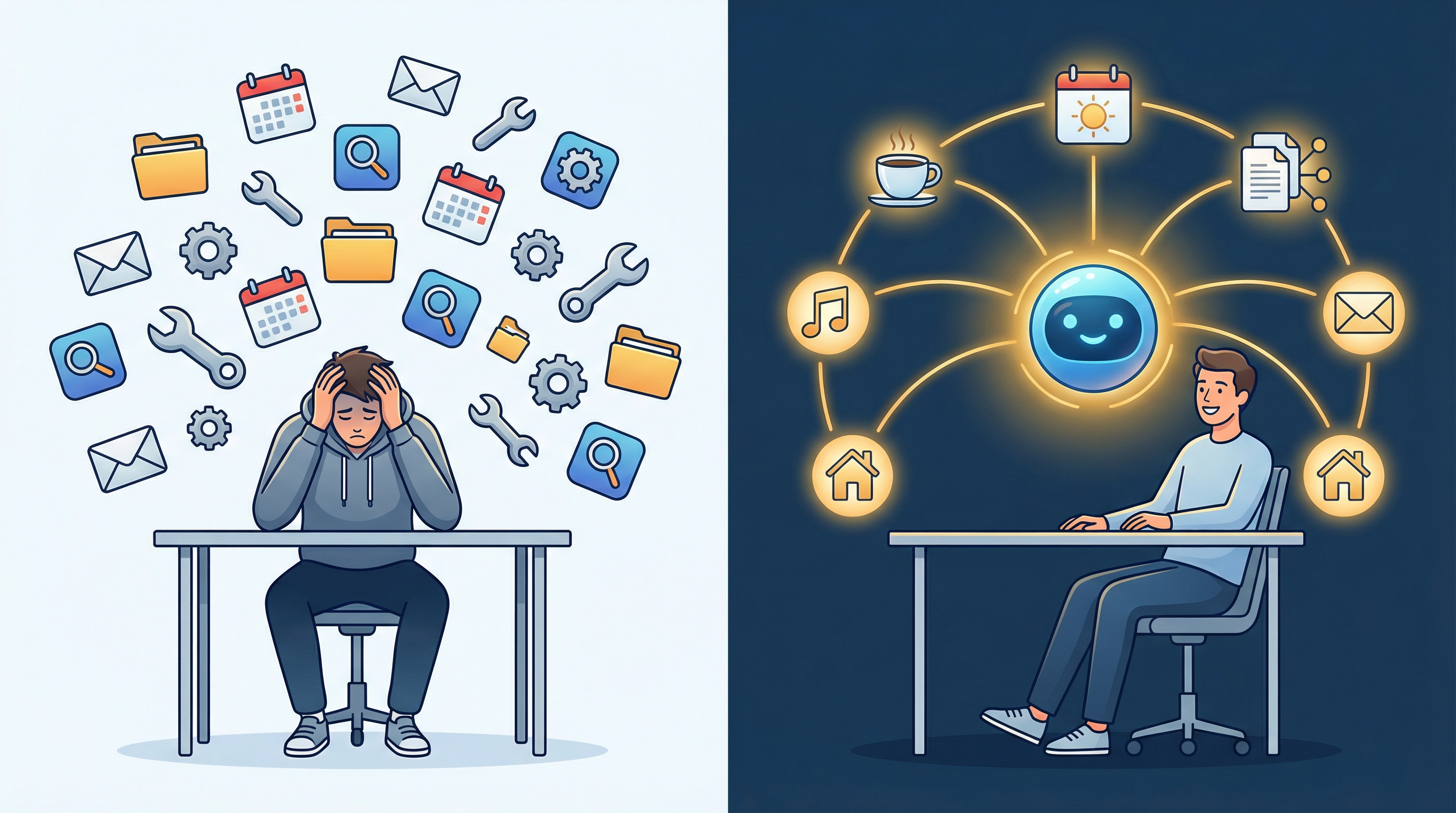
Imagine opening your laptop on a Tuesday morning. Your AI already knows your schedule, your writing style, your project deadlines, and your preferences. You do not explain anything. You just start working.
What would that day actually look like?
Morning: your AI briefs you
It is 7:45 AM. You have not even finished your coffee.
You open your AI assistant and say: “What do I need to know this morning?”
Because your AI knows your calendar, your projects, and your priorities, it responds with something like:
“You have three meetings today. The Meridian project review at 10 AM is the big one — remember you wanted to address the timeline concern from last week. Your draft for the Henderson proposal is due by end of day. Also, the quarterly report template you asked about is ready for your review.”
No searching through email. No scanning your calendar app. No trying to remember what you promised yesterday. Your AI has already connected the dots.
You say: “Pull together my talking points for the Meridian meeting.”
And because your AI knows the project history, your communication style, and what the client cares about, it produces talking points that sound like you wrote them. Because, in a sense, you did — you taught it how you think.
Work: your AI writes in your voice
It is 11 AM. The Meridian meeting went well. Now you need to send a follow-up email.
You say: “Write the follow-up email from the Meridian meeting. Hit on the three decisions we discussed: timeline adjustment, budget reallocation, and the new deliverable format.”
Your AI does not ask “What tone should I use?” It already knows you write client emails that are warm but precise, that you always open with a personal touch, and that you prefer bullet points for action items.
The draft lands in front of you. You read it, change one sentence, and send it. Total time: 90 seconds.
Now compare that to the alternative: opening a blank email, staring at the cursor, trying to remember everything discussed, writing a draft, editing it three times, second-guessing the tone. That is 15 to 20 minutes minimum.
Later that afternoon, you need to write a section of the Henderson proposal. You say: “Draft the methodology section for Henderson. Use the same structure as the Greenfield proposal but adapt it for their healthcare context.”
Your AI knows both proposals. It knows your methodology framework. It knows Henderson is in healthcare and Greenfield was in fintech. The draft reflects all of that — without you explaining any of it.
Thinking: your AI helps you decide
It is 3 PM. You are stuck on a decision.
A potential client wants to hire you for a project that is outside your usual scope. You are not sure whether to take it.
You say: “I’m considering taking on the DataVault project. It’s data governance consulting, which I haven’t done before. The fee is good but the timeline is tight. Help me think through this.”
Your AI knows your current workload, your past projects, your strengths, and the kinds of work that energize you versus drain you. So it does not give you a generic pros-and-cons list. It gives you a personalized analysis:
“Based on your current commitments, taking DataVault would put you at about 115% capacity through March. Your strongest work has been in areas where you have domain expertise — the generic consulting projects tend to take you 40% longer and get lower client satisfaction scores. That said, data governance overlaps with your compliance work for Meridian, so the learning curve might be shorter than you think.”
That is not a magic trick. That is an AI that has absorbed your context over weeks and can reflect it back to you in useful ways.
Personal: your AI knows your life too
It is 7 PM. Work is done.
You are planning a weekend trip and say: “Help me plan Saturday. We want to do something outdoors, remember we talked about that hiking trail near the lake?”
Your AI remembers that conversation from last week. It knows your preference for moderate trails (not extreme hikes), that your partner prefers mornings, and that you always want a good lunch spot nearby.
Or maybe you are an avid reader. You say: “What should I read next?” And your AI — which knows the last twenty books you read and what you said about each one — makes a recommendation that is genuinely tailored to your taste. Not a generic bestseller list. A thoughtful suggestion based on the patterns in what you actually enjoy.
The compound effect
Here is what most people miss about personal AI: the value compounds.
In week one, your AI knows the basics — your name, your role, your preferences. Helpful, but limited.
By week four, it knows your projects, your clients, your writing patterns, your decision-making style. The suggestions get sharper. The drafts need fewer edits. The recommendations hit closer to home.
By month three, working with your AI feels like working with a colleague who genuinely understands you. Not because the technology is magical, but because you invested time in teaching it — and it retained every lesson.
This is exactly like a relationship with a great human assistant. The first week, they are learning. The first month, they are getting good. By the third month, they are anticipating your needs before you voice them.
What this is not
Let us be clear about what personal AI is not. It is not sentient — it does not “care” about you, it follows instructions and patterns. It is not perfect; you will still review and edit output, but you will edit less. It is not effortless to set up: you need to invest some time teaching it, and this course shows you exactly how. And it is not a replacement for thinking. It amplifies your thinking, but you still make the decisions.
Think of it like a really good pair of glasses. The world does not change. But suddenly you can see it much more clearly. And everything you do becomes a little easier, a little faster, and a little better.
The rest of this course
Everything you just imagined — the morning briefings, the personalized writing, the contextual decision-making — is achievable. Not in some future version of AI. Right now, with tools that exist today.
The rest of this course teaches you how to build it, step by step:
- Module 1 (you are here): Understanding what personal AI is and what you want from it
- Module 2: Setting up your workspace — installing the tools, no coding required
- Module 3: Safety and guardrails — what AI gets wrong and how to protect yourself
- Module 4: Teaching your AI about you — the single most important thing you will do
- Module 5: Building your first automation — making Claude work in the background
- Module 6: Bottling your expertise — creating reusable skills from what you know
- Module 7: Connecting your world — giving Claude access to your tools
- Module 8: Organizing your system — keeping everything fast and findable
- Module 9: Designing your daily workflow — morning, work, and evening routines
- Module 10: Structured thinking — a framework for solving complex problems with AI
- Module 11: Growing your system — discovering patterns and building independently
- Module 12: Your personal AI — writing your manifesto and embedding your philosophy
By the end, you will have a working personal AI that knows you, follows your standards, and actually saves you time.
Not generic AI. YOUR AI.
Checkpoint
Before moving on, verify:
- You can picture what a day with personal AI looks like — morning, work, and personal
- You understand the compound effect: AI gets more valuable the longer you use it
- You know what personal AI is NOT (sentient, perfect, effortless, a replacement for thinking)
- You are excited about what is possible — and ready to figure out what you need
What’s next
Before we start building, we need to figure out what YOU actually need. The next lesson helps you create your AI Wishlist — a personalized roadmap for the rest of the course. You will identify the five daily tasks where AI can make the biggest difference in your life.